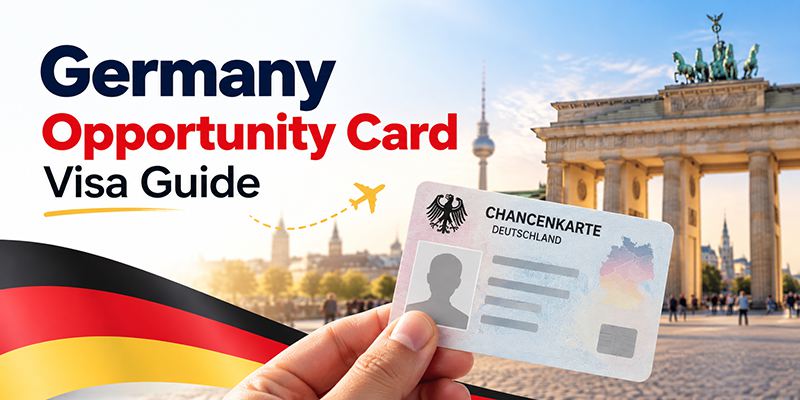
As a Germany-focused job search and immigration consultant, I see skilled professionals miss out on the Chancenkarte (Opportunity Card) not because they lack talent, but because they treat it like a standard visa application rather than a strategic career move.
The Opportunity Card isn't just a entry permit—it is your golden ticket into Europe’s largest industrial powerhouse. But entering Germany without a battle-tested strategy is a recipe for burning through your savings. Here is the definitive breakdown of how the Opportunity Card works and how to actually land a job once you arrive.
1. What Is the Opportunity Card?
Historically, entering Germany to job hunt required a rigid visa with complex prerequisites. The Chancenkarte flips the script:
-
No Initial Job Offer Needed: You can move to Germany for up to 12 months purely to hunt for a job.
-
Earn While You Search: You are legally allowed to work up to 20 hours per week in part-time or side roles to supplement your living costs.
-
Test-Drive Employers: You can complete 2-week trial work periods (Probearbeit) with potential employers-a crucial mechanism to prove your real-world skills to German hiring managers.
-
Seamless In-Country Conversion: Once you secure a full-time offer, you switch directly into a permanent Work Permit or an EU Blue Card without leaving Germany.
2. Industry Demand: Where the Opportunities Are
If your expertise falls into a shortage occupation (Mangelberufe), your odds of securing an offer double. German employers in the following sectors are aggressively recruiting international talent:
-
Information Technology: Cloud Architecture, Cybersecurity, DevOps, Full-Stack Development, Data Engineering, and AI Integration.
-
Engineering: Mechanical, Mechatronics, Automotive, Electrical, and Civil Engineers.
-
Healthcare & Life Sciences: Doctors, Registered Nurses, Radiographers, and Biotech Specialists.
-
Green Energy & Manufacturing: Supply Chain Strategists, Automation Engineers, Renewable Energy Technicians, and Industrial Operations.
-
Skilled Trades & Construction: Electricians, HVAC Technicians, Welders, and Site Supervisors.
3. Qualification Pathways: Choosing Your Route
There are two primary ways to qualify. Knowing which bucket you fall into saves months of administrative delays.
Route 1: Direct Qualified Professional Route
If your university degree or vocational qualification is already deemed fully equivalent (Gleichwertigkeit) to a German qualification (via Anabin or a ZAB Statement of Comparability), you skip the points system entirely. You qualify automatically, provided you meet basic language and financial criteria.
Route 2: The Points-Based Route (Minimum 6 Points Required)
If your degree is recognized in your home country but not yet fully equivalent in Germany, you must score at least 6 points across these criteria:
|
Category |
Criteria |
Points Awarded |
|
Qualifications |
Formal recognition of partial equivalence OR shortage occupation status |
3 Points |
|
Work Experience |
5+ years in your field (within the last 7 years) |
3 Points |
|
2+ years in your field (within the last 5 years) |
2 Points |
|
|
Language Skills |
German Level B2 or higher |
3 Points |
|
German Level B1 |
2 Points |
|
|
German Level A2 |
1 Point |
|
|
English Level C1 (if proficient) |
+1 Extra Point |
|
|
Age |
Under 35 years old at time of application |
2 Points |
|
Between 35 and 40 years old |
1 Point |
|
|
Germany Connection |
Previous legal stay in Germany of at least 6 months (within last 5 years) |
1 Point |
|
Joint Application |
Applying together with a qualifying spouse |
1 Point |
Mandatory Threshold: To enter the points system, you must possess at least A1 German OR B2 English, alongside a recognized 2-year minimum post-secondary qualification.
4. The Financial Reality Check: Blocked Accounts & Budgeting
German authorities require proof that you can cover your cost of living without relying on public assistance.
-
The Blocked Account (Sperrkonto): You must deposit a minimum of €1,091 per month (approximately €13,092 for a 1-year stay) into a regulated German blocked account (e.g., via Expatrio, Coracle, or Fintiba).
-
Alternative Option: A formal Declaration of Commitment (Verpflichtungserklärung) from a sponsor living in Germany who agrees to cover your expenses.
-
Health Insurance: Mandatory incoming health insurance (Inbound/Travel Health Insurance) transitioning to full German private or public health coverage upon arrival.
5. Consultant-Approved Execution Plan: Step-by-Step
-
Verify Your Credentials:
Run your university and degree through the Anabin database. If listed as H+, print the status. If not, apply immediately for a ZAB Statement of Comparability.
-
Standardize Your Application Documents:
-
German-Style CV (Lebenslauf): Tabular format, reverse chronological order, crisp photo, concise bullets detailing technical tools, projects, and measurable impact.
-
Cover Letter (Anschreiben): Tailored directly to German business expectations—direct, formal, and objective.
-
Assemble the Visa File:
Gather valid passport, biometric photos, degree certificates, experience letters, language test reports, and proof of health insurance.
-
Fund the Blocked Account:
Deposit the required funds and secure the official confirmation certificate.
-
Book Appointments & Apply:
Submit via the German Consular Services Portal or your designated regional embassy/VFS center.
6. How to Actually Land a Job in Germany (Insider Advice)
Securing a visa gets you into the country; standing out gets you the contract. Here is how my most successful clients win offers:
-
Learn German early—no exceptions. Even if your daily workplace language is English, German candidates at A2/B1 level receive higher call-back rates than non-German speakers. It shows commitment to integration.
-
Optimize for Xing and LinkedIn. While LinkedIn is dominant for international tech firms, Xing remains widely used by traditional German Mittelstand (medium-sized enterprises) and engineering firms.
-
Target the Mittelstand: Do not limit your search to Berlin or Munich giants like SAP or Siemens. Germany's economic engine relies heavily on hidden champion companies located in regional hubs like Stuttgart, Düsseldorf, or Nürnberg.
-
Use Part-Time Work Strategically: Instead of taking casual retail jobs for your allowed 20 hours/week, target student/working-professional assistant roles (Werkstudent style or working technician) within your target industry.
-
Leverage the 2-Week Trial (Probearbeit): Frame this to hiring managers as a low-risk way for them to evaluate your cultural fit and execution speed before making a full Blue Card commitment.